
How Parmonia uses Cardanit to improve business processes with BPMN and simulation


-
Organization: Parmonia Consultores
-
Design challenge: Help organizations turn undocumented process knowledge into structured, visible and measurable workflows, enabling stakeholders to identify gaps, improve customer service and make better process-improvement decisions.
-
Benefits:
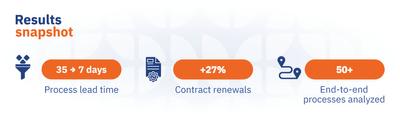
35 days → 7 days: one client process was reduced from 35 days to 7 days after process redesign and implementation.27% increase in contract renewals in 6 months: a service company improved renewals after standardizing its processes and addressing customer-service gaps.50+ end-to-end processes: Parmonia is using Cardanit to document and analyze more than 50 processes for one client's core business area.Better process analysis: BPMN modeling, customization, simulation and heatmap analysis help stakeholders visualize processes, identify gaps and prioritize improvements.
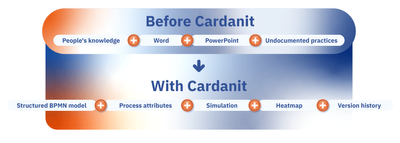
Parmonia uses Cardanit as part of its business transformation and process improvement methodology. The adoption of Cardanit helps organizations turn fragmented process knowledge into structured models that stakeholders can understand, analyze and improve. In many projects, the starting point is not formal process documentation, but information held by employees, scattered across PowerPoint and Word documents, or simply existing in people's experience.
By combining BPMN 2.0 process modeling with structured process information, customization, process simulation and heatmap analysis, Parmonia gives stakeholders a common way to understand how work is actually performed, identify gaps and explore opportunities for improvement.
The approach has contributed to measurable results across client projects. For example one of their client’s processes was reduced from 35 days to 7 days, while a separate service company achieved a 27% increase in contract renewals after standardizing and redesigning its processes.
The ContextBusiness process consulting for undocumented workflows
Parmonia is an international consultancy working with private organizations ranging from startups to large companies and across multiple industries.
Maria Laura Orellana, CEO and business consultant at Parmonia, combines strategic work around business direction, organizational culture and transformation with hands-on process analysis and design.
For Parmonia, Business Process Management is part of a broader transformation methodology. A typical engagement can move through discovery, analysis, design, implementation, testing and refinement.
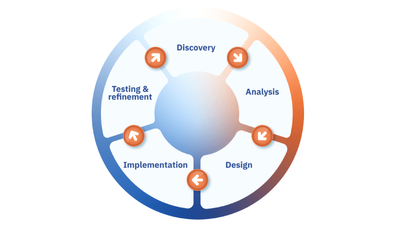
The consultancy takes an end-to-end view of processes. Rather than looking only at the sequence of activities, Parmonia examines the organizational areas and roles involved, the technologies and systems supporting the work, the systems of record, data flows, timings, costs, process ownership, KPIs and risks. While doing this, Laura and the staff at Parmonia always keep in mind the overall business strategy and the transformation initiatives.
This approach means that a process model can become more than a description of how work is performed. It can provide a shared basis for discussing how the organization should improve it by visualizing it in a workflow. The same approach serves as the foundation for understanding how the business operates, its internal and external impact, and complements the data that the same process can provide to support leadership decision-making.
Parmonia's approach is particularly relevant when processes cross departments or when different people have developed different interpretations of how the same work should be performed.
The ChallengeMapping 50+ processes without formal documentation
What happens when processes are not formally documented?
One of Parmonia's current client projects clearly shows the challenge.
The client is reorganizing and redesigning core business activities, with the main objectives of improving customer service and increasing revenue. Parmonia is working through more than 50 end-to-end processes for one of the company's core business areas, with additional processes still to be reviewed.
Before the project, most of the processes were not formally documented. Some information existed in PowerPoint or Word documents, but much of the operational knowledge was held by employees themselves.
To understand one single process, Parmonia conducted interviews with more than 50 people.
The challenge was therefore not simply to draw a workflow. The team first had to establish what the organization actually did and how the different parts of the organization interacted.
That meant identifying:
| What needed to be understood | Why it mattered |
|---|---|
| Organizational areas and departments | To understand where responsibility sits |
| Roles | To identify who performs each activity |
| Activities and decisions | To understand the actual workflow |
| Technologies and systems | To see how work is supported |
| Systems of record | To distinguish authoritative sources of information |
| Data flows | To understand how information moves |
| Timing and costs | To identify performance and efficiency issues |
| Inputs and outputs | To understand what each activity requires and produces |
| Business process owners | To establish accountability |
| KPIs and risks | To measure performance and support resilience |
Identifying the business process owner was particularly important. Laura explains that when a process does not have a clear owner, decisions about improvements or cross-departmental changes can stall.
Therefore, the first challenge was to create a shared understanding of the process and establish who should be responsible for it.
When modeling, the risks become more visible and Parmonia "educates" the business process owner and the executors of the processes about the potential risks that could happen, how they integrate with KPIs and the business strategy, and options to mitigate them when possible.
The SolutionBPMN modeling and simulation for process consulting
From interviews to structured BPMN models
Parmonia uses Cardanit to turn the information gathered during discovery into structured BPMN process models.
The front end for Cardanit is very user friendly. We are talking about business process owners that understand what they are seeing.
The team identifies participants, activities, systems, data and decision points, then brings them together in a model that can be reviewed with the people who actually perform the work.
BPMN provides a common visual language for those discussions. A decision gateway, for example, forces stakeholders to clarify why a decision is made and what happens on each path.
This makes the model useful not only for documenting the process, but also for questioning it.
Instead of discussing a process through several pages of written descriptions, stakeholders can look at the same workflow and ask:
- Where does this activity happen?
- Who is responsible?
- Why does this decision exist?
- What happens if the process follows the other path?
- Which system supports this task?
- Where does the data go?
- Where are activities duplicated?
- Which part of the process needs attention first?
Maria Laura deems visualization as an important part of communicating with decision-makers. Once the process is visible, gaps are easier to identify, discuss and prioritize, providing a stronger basis for improvement decisions and budget allocation.
Visualization tells us more than 100 words.
Adding information beyond the process diagram
For Parmonia, the BPMN model is only one part of the documentation.
Laura consistently uses Cardanit's process attributes to capture information such as process ownership and how it relates to business capabilities, organizational hierarchy, roles, descriptions, process level and other characteristics.
This approach helps create a consistent process architecture rather than a collection of disconnected diagrams.
It also supports the governance of processes over time. Cardanit's version tracking allows Parmonia to retain a history of changes and understand how a process has evolved.
For Laura, this is particularly useful for accountability because stakeholders can see what changed and why. On top of that, it’s a way to show that processes are not static, they evolve together with the business
Using customization to communicate ownership and gaps
Customization also has a practical role in Parmonia's process work.

Customizing elements with different colors to distinguish process areas or ownership
Maria Laura uses colors according to the purpose of the model and the needs of the client. In some cases, different colors help stakeholders distinguish different parts of a process or areas of ownership. She generally prefers using the company's corporate colors when consistency and presentation are the priority.
During process analysis, however, color can take on a different role. Laura uses red to flag something that is unclear, has not yet been validated or may represent a gap or a bottleneck.
This draws the attention of the business process owner and the people executing the process to an issue that needs to be discussed.
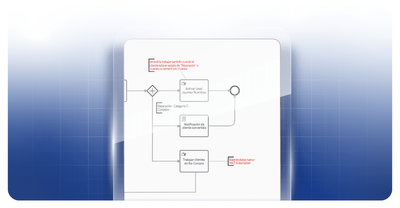
I like to use the red in the process to catch the attention of the business process owner and whoever executes the process.
Cardanit supports this type of customization of colors, fonts and styles, allowing Parmonia to adapt the visual representation to the context in which the process will be discussed.
Using simulation to analyze process performance
Once a process has been modeled and the relevant simulation information has been defined, Parmonia can take the analysis further using Cardanit process simulation.
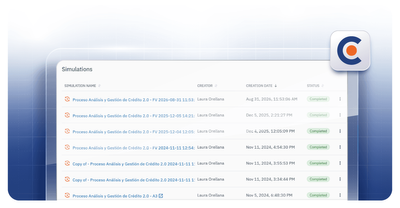
Simulation allows the team to explore how a process behaves under defined conditions and investigate factors such as timing, resources, costs and potential bottlenecks.
Cardanit's simulation documentation explains how simulation can be used to test process performance before implementation.
For Parmonia, this provides another way to investigate the gaps identified during process analysis.
The workflow is important and can be described as:
Model → define simulation parameters → run simulation → analyze results → identify opportunities.
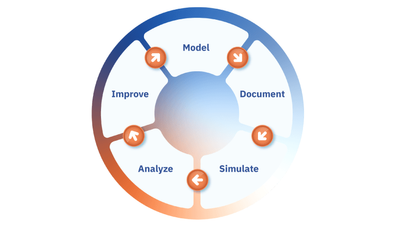
After the simulation is run, the heatmap provides a visual representation of the simulation output. Cardanit uses a color scale to highlight process elements according to the magnitude of the selected result, helping users see where higher or lower values occur.
Laura uses this visualization to help validate the gaps and improvement opportunities she identifies during her work.

“The heatmap is sometimes even more useful than the process itself.”
This is particularly useful when working with business stakeholders. Rather than asking them to interpret simulation data on its own, the heatmap gives them a visual representation of where attention may be needed and action taken.
Cardanit's simulation approach is based on the BPSim standard and is designed to allow users to test process behavior and compare scenarios before making changes to a live process.
For Parmonia, simulation therefore complements process modeling rather than replacing it. The BPMN model provides the structured representation of the process, while simulation can help investigate how that process behaves under defined conditions.
The BenefitsBusiness process improvement through simulation and heatmap analysis
Reducing one process from 35 days to 7
In one project, a process that previously took 35 days was reduced to 7 days following process redesign and implementation.
That means the process became 28 days shorter, an approximately 80% reduction in lead time.
| Before | After | Improvement |
|---|---|---|
| 35 days | 7 days | 28 days shorter |
| 100% of original duration | 20% of original duration | ~80% reduction |
The interview does not establish that Cardanit alone caused this improvement. The result came from the broader process-improvement work, with Cardanit supporting the modeling, analysis and documentation.
Increasing contract renewals by 27%
A separate client engagement produced another measurable result.
This specific client was a service company that had grown without formally standardizing how its services were delivered. Different employees followed different approaches, communication with customers was fragmented, and customers sometimes had to speak to several people before receiving an answer.
The company was experiencing complaints and losing contract renewals.
Parmonia brought the people involved in the service together to establish a common glossary, clarify roles and responsibilities, identify differences in how work was performed and map the process.
The team then identified and prioritized improvement opportunities.
After addressing the first major improvement over a six-month period, the client achieved a 27% increase in contract renewals.
The improvement was supported by a clearer understanding of the process, including criteria, business rules and escalation procedures.
Creating a foundation for continuous process improvement
The value of Cardanit for Parmonia extends beyond individual project results.
Instead of leaving process knowledge in employees' heads or scattered across documents, the consultancy can create structured process models in Cardanit that can be reviewed, updated, versioned and shared.
The models can incorporate important (or relevant) information to ongoing process management, including:
- process ownership
- organizational areas and roles
- inputs and outputs
- timing and costs
- KPIs
- risks and risk strategies
- process versions and changes
This gives Parmonia and its clients a foundation for continuing process analysis rather than treating documentation as a one-time exercise.
Final considerations
Parmonia's experience shows that process improvement often begins before an organization changes anything. It begins by creating a shared understanding of how the process actually works.
Once that foundation exists, teams can ask better questions:
Where are the gaps?
Who owns the process?
Which activities create delays or unnecessary work?
What risks need to be addressed?
What happens if we change the process?
Which improvement should we prioritize?
Cardanit supports Parmonia across all these stages by combining BPMN modeling with structured process information, customization, version tracking, process simulation and heatmap analysis.
The results from its client engagements provide concrete evidence of the broader process-improvement approach: one process was reduced from 35 days to 7 days, while another client achieved a 27% increase in contract renewals after standardizing and redesigning its service processes.
The lesson is not that a modeling tool alone transforms a business. The transformation comes from the methodology, the people involved and the decisions made. Cardanit provides the shared process model and analysis environment that helps those people understand what is happening, identify where change is needed and make those decisions with greater clarity.

María Laura Orellana is Founder and CEO of Parmonia Consultores and a recognized leader in digital transformation, with over 19 years of experience optimizing how organizations and people work together to achieve lasting results. She blends expertise in Agile frameworks, Lean Six Sigma, human-centered design, and automation to deliver measurable impact across industries. Renowned for her curiosity, multicultural mindset, and passion for collective development, María Laura empowers teams to co-design sustainable, human-centered solutions that drive meaningful change.
María Laura Orellana is Founder and CEO of Parmonia Consultores and a recognized leader in digital transformation, with over 19 years of experience optimizing how organizations and people work together to achieve lasting results. She blends expertise in Agile frameworks, Lean Six Sigma, human-centered design, and automation to deliver measurable impact across industries. Renowned for her curiosity, multicultural mindset, and passion for collective development, María Laura empowers teams to co-design sustainable, human-centered solutions that drive meaningful change.
Further reading


A business is only as efficient as its processes. What are you waiting to improve yours?