About Cardanit
Cardanit is a tool for editing business processes and decisions. It’s based on the Business Process Model and Notation (BPMN 2.0) and Decision Model and Notation (DMN 1.3) standards.
Cardanit BPMN and DMN are standalone tools.
Used separately, they enable you to separate business decision logic from the business process, reducing the complexity of business process models and facilitating readability.
Used together, they’re a powerful way to optimize the process of how data, information and objects move between people and systems, and to visualize the decision logic behind every decision in a process.
About BPMN
Business Process Model and Notation (BPMN) is an open standard notation system used to map business processes. The aim of BPMN is to standardize how business processes are modeled and automated.
BPMN visualizes business processes from start to end, showing the sequence of process activities and the information flow between users and systems.
BPMN is widely used in business process management because:
-
It uses a simple visual language that everyone can understand — from technical users like business analysts who create and improve business processes, developers who implement process changes and business managers who monitor changes, to non-technical users like stakeholders who want to understand how a process works.
-
The BPMN standard supports Extensible Markup Language (XML) notation. It facilitates business process automation and enables the platform-independent exchange of BPMN 2.0 diagrams.
BPMN is managed by the non-profit organization Object Management Group (OMG), and is recognized by the International Organization for Standardization (ISO).
About DMN
Decision Model and Notation (DMN) is an open standard notation system used to model and document business decisions. The aim of DMN is to standardize how operational decision-making logic is designed, automated, and shared across organizations.
DMN visualizes decision requirements and business logic, clearly showing the inputs, business rules, and decision-making steps required to arrive at a specific outcome.
DMN is widely used in enterprise decision management because:
-
It bridges the gap between teams by using a precise visual language that’s easy for business stakeholders to read, straightforward for business analysts to configure, and formalized enough for experts to execute or automate.
-
It simplifies complex logic by mapping out explicit business rules and eliminates the need for dense text descriptions or buried code logic.
-
The DMN standard supports XML notation, facilitates automated decision execution and enables the platform-independent exchange of DMN 1.3 models.
DMN is a recognized global standard: Like BPMN, DMN is managed by the Object Management Group (OMG) and is widely adopted across industries to improve corporate governance and compliance.
Tour the Home page
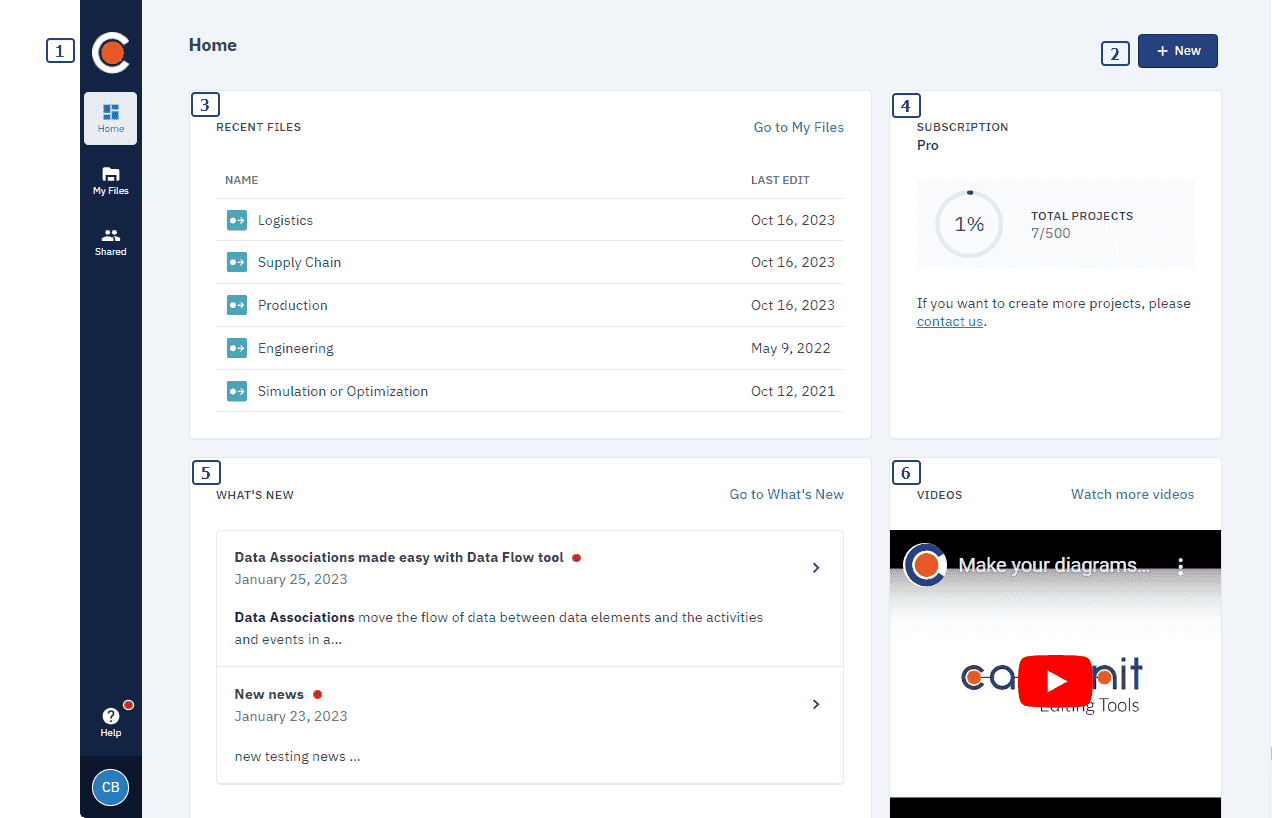
Before you get started, take some time to get to know the Cardanit Home page.
-
Navigation pane
Gives you access to the My Files and Shared pages. It also has a feedback form where you can tell us what you think or find support for an issue, as well as general information about Cardanit. Click your avatar for account details and to log out.
-
New
Create and import BPMN and DMN projects.
-
Recent Files
Shows a list of the most recent projects you and your collaborators have worked on.
-
Subscription
Displays the number of projects you’ve used out of the available projects on your subscription.
-
What’s new
Gives you details on latest features and improvements.
-
Videos
Learn more about Cardanit on the Cardanit YouTube channel.