
Improving pharma regulatory workflows: optimizing the MAA process with BPMN
Written by Andrea

Launching a new drug is a massive milestone in the pharmaceutical product lifecycle and one of the most complex processes a pharma team will ever manage. Every week of delay in the regulatory pipeline translates directly into lost revenue and, more critically, delayed patient access to treatment. In fact, inefficiencies in regulatory submission workflows (fragmented communication, unclear task ownership, untracked document versions) are among the most controllable sources of time-to-market delay.
The European Medicines Agency (EMA) drug approval process, specifically the Marketing Authorisation Application (MAA), is the gateway for pharmaceutical companies to the European Economic Area (EEA). A single authorisation covers the entire European Union but the path to obtaining it is rarely a straight line. Without a structured approach, the MAA's multiple approval bodies (the EMA, the Committee for Medicinal Products for Human Use (CHMP), and the European Commission) combined with the rigorous scientific examination each requires, can make the process feel fragmented and overwhelming.
However, while the procedure is demanding and lengthy, it is also standardized. This makes it highly predictable and optimizable. Whether your new drug reaches the market doesn’t rest on clinical data alone. It also relies on how you manage the flow of information between your team and the evaluation committees.
In an environment defined by strict legal timeframes and "clock stops”, on-point communication is the difference between a drug reaching patients or stalling in the pipeline.
By turning tasks, timelines, and dependencies into visual diagrams, you can transform a fragmented regulatory hurdle into an optimized strategy for market access. This is where BPMN comes in handy.
Why pharma process optimization starts with regulatory workflow
When pharma teams talk about process optimization, the conversation often gravitates toward manufacturing efficiency, supply chain management or clinical trial operations. Regulatory workflow is frequently overlooked yet it is one of the highest-leverage areas for improvement.
The EMA's evaluation runs 210 active days but clock stops can add another 3 to 6 months of calendar time. Teams without a clear internal workflow for responses compilation and clock stop management can lose weeks to internal coordination before any additional data gathering begins.
The causes are predictable:
- Unclear ownership: no single view of who is responsible for each document or decision at a given moment
- Fragmented communication: regulatory affairs, R&D, legal, and medical writing teams operating in silos
- No process visibility: inability to see in real time where a submission stands and what the next step is
- Reactive planning: teams discover bottlenecks after they occur rather than modeling them in advance
These are not clinical but process issues and they are solvable with the right process management approach.
Pharmaceutical workflow optimization and improvement in regulatory affairs means moving from an implicit, document-heavy approach to an explicit, mapped and simulatable process. Teams that map their regulatory processes have fewer last-minute escalations and better cross-functional alignment.
BPMN (Business Process Model and Notation) is the global standard for this kind of process modeling, and the MAA procedure with its defined phases, stakeholders, and legal timeframes is an ideal candidate for BPMN-driven pharma workflow improvement.
Why BPMN for pharma regulatory workflow improvement?
To improve the EMA drug approval process, you need to visualize the workflow and simulate process improvements before implementing them. If you treat the MAA as a static document, you risk missing the "invisible" connections between departments that can cause bottlenecks and delays. This is where Business Process Model and Notation (BPMN) serves its purpose.
BPMN is a standardized method for visualizing complex workflows. It provides a clear, standardized visual language that can turn an abstract regulatory manual into a living, breathing roadmap, making it an essential tool for improving the EMA drug approval process.
For pharma process optimization specifically, BPMN enables you to:
- Map every decision point and handoff: know exactly who handles what and when, from the first submission to the final Commission decision.
- Identify bottlenecks: see where document preparation might slow down or where a "clock stop" requires a surge in resources.
- Bridge cross-functional silos: help stakeholders from R&D, legal, and clinical teams speak the same language using a universal standard.
In the high-stakes environment of regulatory affairs in pharma, process clarity equals speed. Modeling your MAA workflow in Cardanit helps you move from the current “as is” scenario to a data-optimized “to be” process while ensuring total traceability across the entire lifecycle.

Key efficiency outcomes of BPMN-driven process optimization in pharma
Why should pharma regulatory affairs teams switch to BPMN mapping? Here are the facts:
- Standardization: use consistent symbols so everyone—from your internal team to external consultants—understands the map immediately.
- Total visibility: see the end-to-end flow. This makes it easy to spot non-value-added activities or potential compliance gaps before they become troublesome.
- Team alignment: when you align on the process scope before execution, you drastically reduce rework and late-stage delays.
- Predictability: Cardanit business process simulation allows you to simulate workflows. You can test "what-if" scenarios regarding resource allocation or how a delay in one lane affects the final submission date.
- Audit readiness: in drug regulatory affairs, if it isn’t documented, it didn’t happen. BPMN ensures every step is traceable, compliant, and ready for scrutiny.
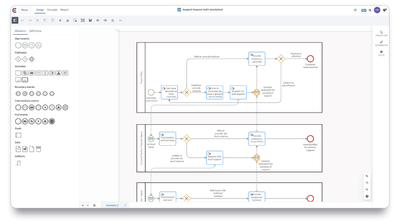
Regulatory workflows are based on traceability. Cardanit follows the BPMN 2.0 standard, so your regulatory workflows stand up to internal and external reviews.
The practical guide: designing and simulating the workflow
To help you visualize the MAA Process in lanes, diagrams and tasks and introduce you to Cardanit BPMN modeling and simulation features, we’ve mapped the high-level flow of the EMA approval process. You can take it from here and structure all the subprocesses related to specific procedural activities of specific stakeholders.
Ready to start? Here’s how you can design a robust MAA workflow using Cardanit.
1. Define the Pool and Lanes
Start by identifying the actors. In an MAA process, you’ll likely have lanes for the Applicant (your company), the EMA/Rapporteurs, and the European Commission. In general, lanes are used in BPMN visual representation to create clear accountability for every task and prevent "lost" communications.
2. Map the milestones
Front-load the important stages of the EMA drug approval process. Include the initial submission, the validation phase, and the critical evaluation phases. Don't forget to model the "Clock Stop" after Day 120—this is a vital part of the pharmaceutical drug regulatory affairs timeline.
3. Use the Subprocess for the day 120 phase
The Day 120 phase is perhaps the most critical moment in the timeline. Your team must address the List of Questions (LoQ) with absolute precision to keep the process moving. We represented it with these specific elements to manage it:
- Intermediate Catch Event (Timer): This represents the "Clock Stop." It keeps the countdown (usually 3 to 6 months) visible to the whole team.

- Data Objects: Link specific documents like the "Response to the List of Questions" to specific tasks to ensure the right version is always used.

- Exclusive Gateway: Create an internal review loop. Does the response meet all EMA requirements? If not, the loop ensures it goes back for drafting before the final submission.

- Parallel Gateway: Use it to represent tasks occurring concurrently but independently from one another. It breaks a flow into parallel paths and ensures the process only continues once all parallel activities are finalized.

- Subprocess: Use it to represent your team’s tasks that are specific to the Response to the List of Questions. It’s embedded within the Process and helps simplify complex models by organizing work into manageable units.

| BPMN element | Role in MAA process | Benefit for Regulatory Affairs |
|---|---|---|
| Pools & Lanes | Define roles (Applicant, EMA/Rapporteurs, Scientific Committee, European Commission). | Ensures clear accountability and ownership. |
| Intermediate Catch Event | Models "Clock Stops" and legal deadlines. | Keeps the team focused on strict EMA timelines. |
| Data Object | Represents the eCTD or specific documents, such as 120 List of Questions (LoQ). | Ensures document traceability and audit readiness. |
| Exclusive Gateway | Internal quality gates and review loops. | Reduces rework by catching errors before submission. |
| Parallel Gateway | Enables multiple activities to proceed simultaneously. | Improves transparency across tasks. |
| Subprocess | Groups related activities together. | Represents specific subtasks for more manageable workflows. |
4. Simulate pharma workflow improvements before implementation
Before you go live, use Cardanit features to check your process logic. Rather than discovering inefficiencies during a live submission, Cardanit business process simulation lets you stress-test your current workflow against realistic scenarios and validate process improvements in advance.
For pharma regulatory affairs teams, the most valuable simulation scenarios include:
- Resource bottleneck modeling: what happens to your Day 120 LoQ response timeline if your team is reduced by 20%?
- Clock stop response windows: how many days of buffer do you actually have and which tasks are on the critical path?
- Parallel workstream optimization: which activities can genuinely run concurrently and what are the dependencies that prevent it?
Let’s zoom into a sub-process and use it as a simulation example. To start your simulation, simply switch from the Design tab to the Simulation tab and add your BPSim parameters. You can define:
- Trigger time for the start event: set how many times the process can be triggered and the time interval between each occurrence. For example, if you handle 10 drug approvals a year, you can set an interval of 30 days between each LoQ submission.

- Task-level parameters: for each task, you can assign different parameters.
- Processing time: Set the average time each task takes to complete. This is especially useful for estimating task duration within a defined time frame, as in your case. When assigning processing time to the LoQ assessment task, we used a uniform distribution to simulate the effort required to assess the List of Questions—between a minimum of 7 days and a maximum of 10 days.
- Calendars: When tasks follow a fixed schedule—such as a 2–3 month timeframe, as in your case—you can define calendar dates. For instance, if you aim to complete the LoQ preparation between February 2 and April 2, you can select those dates in the calendar and then link the calendar to the trigger time.
- Costs: You can assign costs to track monetary expenses related to task execution. In this scenario, it’s advisable to use fixed costs tied to resource expenses. In our example, no costs were assigned.

- Exclusive gateway probabilities: You can estimate the probability of each decision outcome, such as positive or negative paths.

After you’ve configured the simulation properties, run the simulation and see how everything comes together through Cardanit’s data visualization tools. These tools convert raw numbers into clear, easy-to-understand graphics for all stakeholders.
- Tables: present numeric results across rows and columns for all outputs, including tokens, task processing time and duration, costs, and resources. You can filter and sort through activities and simulation data to visualize the insights you’re most interested in.

- Heatmaps: the most representative visualization tool, as they highlight bottlenecks—such as long processing times, as shown in this example—using a color scale from hot red to cool green applied directly to activities.

- Bar charts: provide a clear comparison of how BPMN elements perform across selected parameters and help you easily identify bottlenecks. In your case, a bar chart helps highlight tasks with minimum and maximum completion times, supporting better resource allocation and allowing you to structure your process more efficiently.

The improvement process doesn’t stop here. After running the first simulation of your as-is process and analyzing the results, you can identify improvement opportunities and test alternative scenarios within the EMA drug approval process. This allows you to progress from your current “as-is” scenario to a streamlined “to-be” process.
These improvements can include:
- Redesigning the overall workflow to streamline activities
- Reallocating resources to reduce processing time
- Adjusting parameters to optimize overall outcomes
These are key advantages of Business Process Simulation in Cardanit. Cardanit BPSim allows you to stress-test your current process and explore the impact of potential improvements before implementation. This is an essential capability when managing the complexity of the EMA drug approval process.
Simulation reduces the risk of ineffective changes through data-driven decision-making. It also bridges the gap between planning and execution, ensuring your processes are aligned with organizational goals and ready for deployment in pharmaceutical drug regulatory affairs.
Plus, sharing your projects with stakeholders is only a click away. With real-time process alignment, you always know who is involved in each stage of the process, where the workflow stands, and where the relevant documents are.
Summary
The EMA drug approval process is complex, but it doesn't have to be a black box. By using BPMN to map your MAA journey, you turn a fragmented procedure into a streamlined, detailed workflow. You gain more than just a diagram; you gain a roadmap to regulatory success that keeps your team aligned and your submission on track.
In a nutshell, the key advantages of using BPMN in regulatory affairs are:
- Workflow clarity and standardization: Mapping processes clarifies roles, tasks, and timelines.
- Improved cross-team collaboration: Alignment across teams reduces miscommunication and delays.
- Data-driven process optimization: Workflow simulation enables data-based process improvements.
- Traceability and compliance: All tasks, documents, and decisions are fully documented and audit-ready.
At Cardanit, we’re always looking for ways to make complex architectures easier to manage. Whether you’re a pro player in regulatory affairs or just starting your first submission, Cardanit gives you the precision and compliance you need to succeed.
Andrea is the collective pseudonym for the group of people working behind Cardanit, the Business Process Management Software as a Service of ESTECO. The group has different backgrounds and several decades of experience in fields varying from BPM, BPMN, DMN, Process Mining, Simulation, Optimization, Numerical Methods, Research and Development, and Marketing.
Andrea is the collective pseudonym for the group of people working behind Cardanit, the Business Process Management Software as a Service of ESTECO. The group has different backgrounds and several decades of experience in fields varying from BPM, BPMN, DMN, Process Mining, Simulation, Optimization, Numerical Methods, Research and Development, and Marketing.
People also ask
BPMN 2.0 is the global standard for process modeling, offering rich, standardized diagrams that provide the precision required for technical audits and legal compliance. This universal language ensures that regulatory requirements are easily mapped and auditable. Unlike simple flowcharts, its XML-based structure also enables automated verification to guarantee that all regulatory mandates are met.
DMN complements BPMN by separating decision logic from the process flow, keeping diagrams clean and manageable. In Cardanit, DMN decision tables link to BPMN Business Rule Tasks to provide a transparent, precise record of regulatory decision-making.
Choose Cardanit for its intuitive interface and real-time collaboration feature that requires no installation. Cardanit expertly balances ease of use with full BPMN 2.0 compliance and BPSim capabilities for stress-testing critical processes. Try it now.
A business is only as efficient as its processes. What are you waiting to improve yours?