
From boxes and arrows to better decisions: what process modeling is really for
Written by Filip Hendrickx
8 May 2026 · 6 min read

As Business Analysts, a key distinction we make is between output and outcome. A consultant may deliver slides. A process analyst may deliver process models: boxes, arrows, swimlanes. That's their output. The real value or outcome of the process diagram comes from creating shared understanding and enabling better-informed decisions.
Facilitating conversations around formal process models helps process analysts drive better understanding. Leveraging historical and expected process execution data lets process analysts move their stakeholders from gut feeling to data-driven process improvement decisions. By adding rigor and identifying process pitfalls and opportunities, effective process modeling and simulation tools support process analysts in helping stakeholders reach those decisions.
The real value lives in the questions
When you sit down with a team and start mapping a process, something interesting happens. People who have worked alongside each other for years discover they have completely different mental models of how the same work actually flows. The person doing the handoff assumes the recipient knows what to do next. The recipient has been improvising for months.
A structured process model, a visual representation of how work flows across people, systems, and decisions within an organization, drawn in front of both stakeholders surfaces that gap in about ten minutes. No diagram, no discovery.
This is why the rigor of a formal modeling language like BPMN matters, even when it feels like overhead.
Each notation element is a question in disguise:
- A gateway asks: who decides, and on what basis?
- A message event asks: what triggers this, and from where?
- A data object asks: does this information actually exist at this point in the process, or are we assuming it does?
The constraint is the guide. The structure provokes clarity. Both drive questions and conversations.
But don't confuse the map for the territory
Here's where practitioners need to stay honest with themselves and their clients.
The statistician George Box famously observed that all models are wrong, but some are useful. Process models are no different. They represent a version of reality: a partial, simplified, and for communication reasons necessarily incomplete version. The team's best collective understanding of how things work, captured at a point in time, filtered through the lens of whoever was in the room.
That's still enormously valuable. A structured BPMN model gives you better information than a whiteboard sketch, which gives you better information than a verbal description, which gives you better information than nothing. The rigor compounds the clarity.
But a process optimization decision based on even the best model is still a decision based on what you think will happen, not what you know will happen.
Where simulation changes the equation
Testing multiple process redesigns in real operations is almost never feasible. You can't run three versions of your mortgage approval process simultaneously to see which performs best. The cost, in time, risk, and organizational disruption, is prohibitive.
This is where process simulation earns its place.
Take a practical example: a financial services team is exploring whether to centralize document verification or keep it distributed across regional teams. Both options look reasonable on paper. But when you parameterize the model with actual volumes, realistic task durations, resource availability, exception rates, the simulation tells a different story. The centralized model improves average throughput but creates a bottleneck during month-end peaks that the distributed model handles more gracefully.
That insight, surfaced through simulation before any reorganization decision is made, is worth considerably more than the time it took to model.
Simulation doesn't eliminate uncertainty. But it replaces speculation with structured evidence, or better questions to explore before rollout. It shifts the question from "which option seems better?" to "under what conditions does each option perform better, and which conditions are we actually likely to face?"
The whiteboard objection and why it doesn't hold
There's a common objection to all of this: whiteboards are faster, more flexible, easier to use in a room full of stakeholders. Why introduce a modeling tool and a notation standard when a marker and a wall will do?
For initial exploration, the objection has merit. A rough sketch in the first workshop is fine, often an ideal starting point. Rich, unstructured pictures capture nuances that formal notation can't.
The problem comes next. That whiteboard doesn't answer questions. It doesn't tell you whether the process matches reality, is consistent, complete, or even internally coherent. It can't be simulated. It can't be searched, versioned, reused, or compared against a future state. The moment you want to move from capturing a stakeholder's view on a process to analyzing and improving it, the whiteboard has serious limitations.
The real question isn't whiteboard vs. modeling tool. It's: at what point in the engagement does informal sketching stop being enough?
For most serious process work and with the right tool at your fingertips, that point comes earlier than people expect.

Clear diagrams, real-time collaboration and none of the usual friction. See what makes Cardanit stand out:
What good tooling actually enables
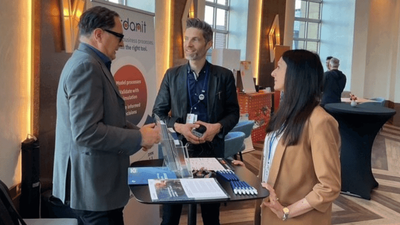
Filip Hendrickx talking to Cardanit Marketing and Product Managers at the BA & Beyond 25 Conference
The practical barrier to structured process modeling has historically been friction: steep learning curves, clunky interfaces, tools built for specialists rather than for the consulting room. That barrier has lowered significantly.
Modern BPMN tools like Cardanit are designed for collaborative working, offline and online: building models with clients and process owners in real time, sharing both whiteboard drafts which stakeholders recognize and formal process models for async review, iterating quickly. The simulation capability sits alongside the modeling, not in a separate system requiring specialist knowledge to operate.
But the deeper benefit is less visible: reusable process knowledge. When models are stored, structured, and searchable, they don't die when the engagement ends.
A process library built over multiple engagements becomes:
- a genuine asset,
- a reference point for future work,
- a baseline for measuring change,
- a way to onboard new team members into how the organization actually operates.
That's the shift from process modeling as a deliverable to process modeling as a capability.
A practical starting point
If you're a consultant or internal advisor looking to get more from process work, the sequence is straightforward:
- Start with conversation, not notation. Use informal sketching to understand the territory and build trust with stakeholders. Don't arrive with a blank BPMN canvas and ask people to populate it. Stakeholders know their process inputs, activities, and outputs. Use the conversation to make them understand the wider picture around their work.
- Formalize before exploring improvements. The rigor of BPMN, guided by a user-friendly tool, will raise inconsistencies and inaccuracies invisible on a whiteboard sketch. A well-structured, clearly laid out, and precise model will enable deeper understanding. Better process knowledge will drive better improvement suggestions: restructuring a team, changing a handoff, introducing automation.
- Simulate before you commit to a process change decision. For any process change with meaningful cost or risk, use simulation to pressure-test the options. Define the parameters based on real data where you have it, reasonable estimates where you don't. The output won't be perfect, but it will be better than intuition alone.
- Treat the model as an asset, not a slide. Document it, version it, make it findable. The value compounds when models outlive the engagement that created them. Treat the model as a digital twin of part of your organization that you continuously update and that you can query for potential improvements.
Conclusion
The consultants who draw the most useful diagrams aren't the ones with the neatest notation. They're the ones who know exactly what question the diagram is supposed to answer, who keep asking better ones, and who leverage helpful tools so they can focus on the conversation.
Filip inspires BA professionals as a global speaker, author, trainer, coach, conference organiser, IIBA® Board of Directors member, and Visiting Professor. Through his current activities and his past IIBA Brussels Chapter Presidency, Filip is a driving force in fostering the BA profession and global community. Filip’s dedication was recognised with the 2022 and 2024 IIBA EMEA Region Volunteer of the Year Award. Together with Ian Richards, Filip is the author of Brainy Glue, a business novel on business analysis, innovation and change. Filip is also co-author of the BCS book Digital Product Management and of Cycles, a book, method and toolkit enabling faster innovation. As he loves to connect, you can contact Filip on LinkedIn anytime.
Filip inspires BA professionals as a global speaker, author, trainer, coach, conference organiser, IIBA® Board of Directors member, and Visiting Professor. Through his current activities and his past IIBA Brussels Chapter Presidency, Filip is a driving force in fostering the BA profession and global community. Filip’s dedication was recognised with the 2022 and 2024 IIBA EMEA Region Volunteer of the Year Award. Together with Ian Richards, Filip is the author of Brainy Glue, a business novel on business analysis, innovation and change. Filip is also co-author of the BCS book Digital Product Management and of Cycles, a book, method and toolkit enabling faster innovation. As he loves to connect, you can contact Filip on LinkedIn anytime.
A business is only as efficient as its processes. What are you waiting to improve yours?