
BA & Beyond 2026 Belgium: why empathy might become the most important AI skill for business analysts
Written by Piero Donat
22 May 2026 · 6 min read
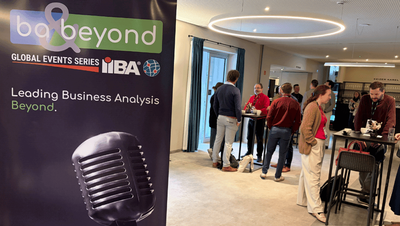
For the second year in a row, I had the pleasure of attending the Belgian leg of BA & Beyond 2026 Convergence in Mechelen. Once again it confirmed why this event is quickly becoming one of the most interesting gatherings in Europe for business analysts, process modeling professionals, decision-makers, and AI practitioners.
Organised with remarkable energy by people like Filip Hendrickx, Wouter Nieuwenburg and the incredible Belgian IIBA volunteer community, the conference manages to achieve something rare: it talks seriously about AI without turning every session into a “robots will replace us by lunchtime” TED Talk speedrun.
Instead, BA & Beyond 2026 focused on a much more valuable conversation: how business analysts can challenge AI outputs, inject human judgment, improve communication, and use empathy, modeling, and critical thinking to create better outcomes.
If you’re searching for insights on AI in business analysis, agentic AI for BAs, requirements engineering with AI, BPMN and AI process optimization, or the future role of business analysts in an AI-driven world, this conference delivered plenty of material worth discussing.
And before diving into the talks: Mechelen was a lovely surprise. Small, elegant, almost suspiciously picturesque. One of those cities where every street quietly whispers, “slow down a bit.” Walking through the historic centre felt like temporarily exiting the LinkedIn feed dimension and re-entering reality.
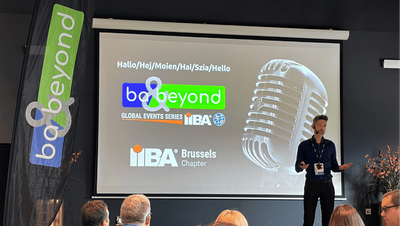
BA & Beyond organizer Filip Hendricks gives his welcome speech
AI was everywhere. Empathy was the real headline.
Last year, the dominant theme at BA & Beyond was understandably AI itself. This year, AI was still everywhere, but empathy echoed through the corridors of the venue almost as loudly as prompts, copilots, and agentic workflows.
Many speakers explored not only how AI can accelerate analysis and delivery, but also how analysts must become better at challenging assumptions, facilitating conversations, validating outcomes, and understanding the people behind requirements.
In other words: the future BA may spend less time formatting documents and more time acting as a translator between humans, systems, ambiguity, and increasingly overconfident AI outputs.
Which, frankly, sounds healthier than spending eight hours arguing over Excel column names.
Vadim Deylgat and the empathy toolkit every BA should carry
One of the standout sessions of day one was Vadim Deylgat’s The Empathy Edge: Techniques for Effective Communication.
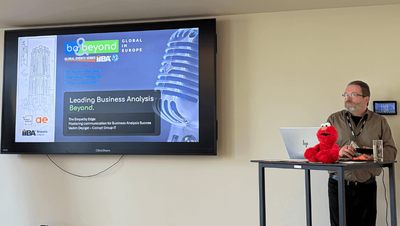
Vadim brought together psychology, recruitment, consulting, business analysis, and AI enablement into a practical session that felt immediately applicable. His core distinction between empathy and sympathy was refreshingly clear:
- empathy is understanding emotions without becoming absorbed by them
- sympathy is joining the emotion itself.
For analysts, that distinction is huge.
The session explored empathy mapping, active listening, labeling emotions, mirroring conversations, and even the linguistic traps that silently damage communication. One particularly memorable takeaway was how words like “why” can often sound accusatory rather than exploratory.
Another gem: don’t ask “How are you?” Ask “What’s good?”
Tiny linguistic changes. Massive difference in energy.
Vadim’s session also reinforced something that came back repeatedly throughout the conference: AI can generate artifacts, but human communication remains stubbornly, gloriously human.
And honestly, hearing a room full of BAs discussing emotional intelligence with this level of seriousness was refreshing. Somewhere, a requirements document probably developed feelings.
Clarity is social, not individual
Lucrezia Ponzano delivered another highlight with Clarity Is a Social Process.
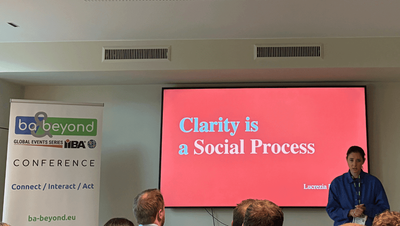
This session tackled something every analyst recognises: the illusion that clarity appears magically because someone wrote a document.
Instead, Lucrezia argued that clarity emerges through structured conversations, visible differences, and deliberate pauses before jumping to solutions.
Her three principles stayed with me:
- make differences visible
- slow down before deciding
- structure the conversation, not the answer.
That line alone probably deserves to be framed above half the meeting rooms in Europe.
In a world increasingly driven by AI-generated outputs, her message landed particularly well: data may now be the starting point, but human alignment is where value is actually created.
Dirk Verreycken on prioritization, complexity, and reality
Dirk Verreycken’s session on product management in higher education also stood out for its practical realism.
Instead of presenting prioritisation as a perfect mathematical exercise, Dirk showed how subjective discussion and collaboration often work better than pretending estimates are scientific truth carved into stone tablets.
His references to the Spotify model, backlog prioritisation, cost of delay, and the Cynefin framework sparked several conversations afterward.
One particularly interesting point was his idea that complexity often reduces when you pull things apart correctly. Complicated problems are manageable. Complex ones require communication, experimentation, and adaptability.
A useful reminder for anyone currently trying to “solve AI strategy” in one workshop and three sticky notes.
The panel that quietly stole day one
The closing panel featuring Delvin Fletcher, Ann Leemans, Vincent Mirabelli, Dami Junaid and Mark Bruins was one of the strongest moments of the conference.
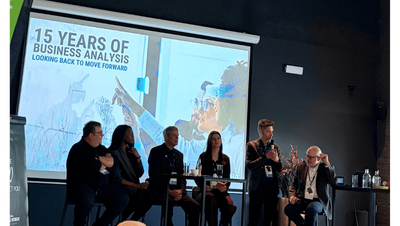
Filip Hendrickx introducing the panel with Vincent Mirabelli, Dami Junaid, Mark Bruins, Ann Leemans and Delvin Fletcher
There was honesty in the discussion that felt very different from the polished certainty often surrounding AI conversations online.
A few themes emerged repeatedly:
- AI will create artifacts faster
- human skills become more important, not less
- collaboration and stakeholder engagement remain critical
- analysts increasingly become decision architects.
One quote that stayed with me came from Vincent Mirabelli:
“AI is not going to replace a BA, but a BA using AI knows how not to be replaced by AI.”
Day two: agentic AI, orchestration, and controlled failure labs
If day one balanced empathy and AI, day two went much deeper into agentic workflows and AI-enabled delivery.
Jon Buttriss explored how BAs can drive agentic orchestration rather than merely consume AI tools passively.
His framing of AI evolving from tooling to thinking partner to agentic execution sums up pretty much his vision of where AI usage is going.
Jon insisted that professionals need to move back and forth between those modes rather than blindly automating everything.
That nuance is often missing online, where discussions about AI tend to oscillate between “AI will save civilization” and “we’re all becoming decorative houseplants.”
Stijn Van Schoonlandt delivered the session everybody kept talking about
Then came Stijn Van Schoonlandt.
Again.
After last year’s excellent session, this year simply confirmed that if Stijn is speaking at BA & Beyond, you go to the room early. Possibly bring snacks. Maybe reserve seating with tiny BPMN cones.
His workshop, Your specification is the product: a controlled failure lab with AI, was one of the most practical and forward-looking sessions of the conference.
Instead of presenting AI as magic, Stijn focused on:
- validating outputs
- challenging assumptions
- creating review loops
- building specialised agents
- treating specifications as evolving systems rather than static documents.
One particularly powerful idea was that “an agent is never finished.”
That sentence perfectly summarises where many organisations are today. AI systems require continuous refinement, validation, and governance. Analysts are becoming reviewers, orchestrators, and quality challengers.
His live demonstrations showed how AI agents can:
- collect information
- question incomplete requirements
- review their own work
- refine outputs iteratively.
The approach felt applicable across sectors, not just software delivery.
And perhaps most importantly, it reinforced a recurring conference theme: AI works best when challenged properly.
Blind trust is not strategy. It’s just automation wearing sunglasses indoors.
The future BA may look very different
One of the strongest conclusions from BA & Beyond 2026 Belgium is that the role of the business analyst is evolving rapidly, but not disappearing.
If anything, the profession is becoming more strategic.
The future BA may increasingly act as:
- decision architect
- AI challenger
- conversation facilitator
- orchestration specialist
- process intelligence guide
- empathy-driven communicator.
The analysts who thrive will probably not be the ones producing the most documents manually.
They will be the ones asking better questions.
And perhaps that was the real message resonating through Mechelen this year: in an AI-driven world, human judgment becomes more valuable precisely because automation becomes easier.
Also, never trust a requirements document that asks zero follow-up questions. That’s not a specification. That’s a suspense thriller.
Final thoughts
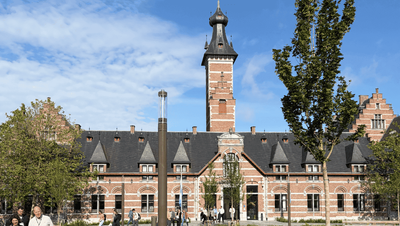
The conference venue: Van der Valk Hotel Mechelen
BA & Beyond Belgium continues to grow into something genuinely valuable for the European business analysis community.
It combines practical content, thoughtful discussion, strong speakers, and enough intellectual curiosity to avoid becoming yet another conference where every slide contains the word “disruption” in 72pt font.
Huge credit again to the Belgian IIBA volunteers, organisers, speakers, and attendees for creating an environment that feels both deeply professional and remarkably human.
And thank you, Mechelen, for the beautiful streets, excellent conversations, and for proving once again that some of the best ideas happen between conference rooms, coffee machines, and slightly over-ambitious discussions about AI agents.
Piero is the Marketing Manager of Cardanit, the easy-to-use collaborative BPM software as a service for modeling and simulating business processes in aid of decision-making. With extensive experience in UK and international environments, Piero enjoys his marketing role in the BPM arena to the point he got a certificate in BA from BCS, The Chartered Institute for IT.
Piero is the Marketing Manager of Cardanit, the easy-to-use collaborative BPM software as a service for modeling and simulating business processes in aid of decision-making. With extensive experience in UK and international environments, Piero enjoys his marketing role in the BPM arena to the point he got a certificate in BA from BCS, The Chartered Institute for IT.
A business is only as efficient as its processes. What are you waiting to improve yours?