Add components
There are several ways to add components to a diagram.
-
From the Navigation panel.
-
Using the right-click menu.
-
Using connection points.
-
Using the Magnetic Edge tool.
From the Navigation panel
The Navigation panel contains all the components you can use in a diagram.
-
In the toolbar, click
to open the Navigation panel. -
Select a component, then drag and drop it onto the diagram.
The right-click menu
Right-click an empty point of the diagram to open the menu. This opens the same categories as the Navigation panel.
-
Right-click an empty point of the diagram.
-
Select a category, then select the component you want to add.
Connection points
When you select a component, four connection points appear around it — one on each side.
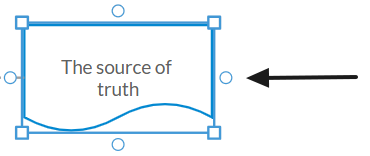
-
Select a component on the diagram.
-
Select a connection point and drag to an empty area of the diagram, then release.
The Component menu opens.
-
Select a component from the Component menu.
The component is automatically connected to the selected component.
Copy and paste
You can add components by copying an existing one and pasting it elsewhere.
-
Select the component you want to copy.
-
In the action toolbar, click
and select Copy. -
Right-click an empty point of the diagram to open the right-click menu, then select Paste.
Other ways to copy and paste
-
Select a component, click
then select Cut. Right-click an empty point of the diagram and in the menu, select Paste. -
Toolbar: Use the copy
and paste actions. -
Keyboard shortcuts: Ctrl + C to copy and Ctrl + V to paste.
Magnetic edge
The Magnetic Edge tool automatically connects components as you drag and drop them onto your diagram. Think of it like a magnet; it connects to the closest component.
-
In the toolbar, click
. -
Drag a component from the Navigation panel and drop it onto the diagram.
-
Drag another component close to the first one. The Magnetic Edge tool will automatically connect them when they’re positioned correctly.
To deactivate the tool:
- In the toolbar, click
 .
.
Hide components
You can hide components in a diagram when you want to focus on an area of the decision tree without the distraction of unwanted components.
When you hide a component, the marker  is added to the component the hidden component was connected to.
The components you hide are placed in the Navigation panel under the Available elements section.
You can restore a hidden component. If it was connected to other components, the links are automatically restored.
To hide a component:
-
Select the component.
-
In the action toolbar, click
.
To restore a hidden component to a diagram:
- In the Navigation panel, in Available elements, select the component, hold, then drag and drop it onto the diagram.
Delete components
There are two ways to delete components.
-
Select the component or components and in the Toolbar, click
. -
Select the component or components and in the action toolbar, click
and select Delete.
Undo and redo actions
When you’re adding components to a diagram or editing them, it can be useful to undo and redo your actions.
You find the undo